Bigha to Acre Conversion by State (India)
One bigha is not one size. Compare all thirteen states in a single table, or select yours in the converter to see the exact figure with its local variants.
Choose your state for an accurate figure
Result
1.6bigha
1 acre in General reference (no state selected)
1 acre = 1.6 bigha (General reference (no state selected))
- square feet
- 43,560
- square yards
- 4,840
- square metres
- 4,046.86
- hectares
- 0.4047
- Conversion rate used
- 1 acre = 1.6 bigha in General reference (no state selected)
- How this bigha is defined
- 1 bigha = 27,225 square feet — 3,025 sq yd — the pucca bigha of the North Indian revenue system
This is the figure behind the popular shorthand '1 acre = 1.6 bigha'. It reflects the North Indian pucca bigha and is NOT correct for West Bengal, Assam, Gujarat, Punjab, Haryana, Madhya Pradesh, Himachal Pradesh or Uttarakhand. Select your state for a usable number.
| State | 1 bigha (sq ft) | Bigha per acre | 1 bigha in acres | Traditional definition and local variants |
|---|---|---|---|---|
| 6,806.25 | 6.4 | 0.1563 | 756.25 sq yd — the hill-district bigha
| |
| 8,712 | 5 | 0.2 | 968 sq yd — exactly 5 bigha to an acre | |
| 12,000 | 3.63 | 0.2755 | 20 katha of 600 sq ft each | |
| 12,000 | 3.63 | 0.2755 | Follows the Madhya Pradesh convention of 20 katha of 600 sq ft | |
| 14,400 | 3.025 | 0.3306 | 1,600 sq yd = 20 katha (exactly 40/121 acre) | |
| 14,400 | 3.025 | 0.3306 | 1,600 sq yd = 5 katha of 2,880 sq ft each | |
| 17,424 | 2.5 | 0.4 | 16 guntha of 1,089 sq ft (bigha and vigha are used interchangeably)
| |
| 21,780 | 2 | 0.5 | 4 kanal = 2,420 sq yd (exactly half an acre)
| |
| 21,780 | 2 | 0.5 | 4 kanal = 2,420 sq yd (exactly half an acre)
| |
| 27,225 | 1.6 | 0.625 | 20 biswa = 3,025 sq yd (pucca bigha, eastern UP and the Lucknow belt)
| |
| 27,225 | 1.6 | 0.625 | 20 katha = 3,025 sq yd (Patna region) | |
| 27,225 | 1.6 | 0.625 | Pucca bigha = 3,025 sq yd
| |
| 27,225 | 1.6 | 0.625 | Follows the Bihar convention of 20 katha = 3,025 sq yd |
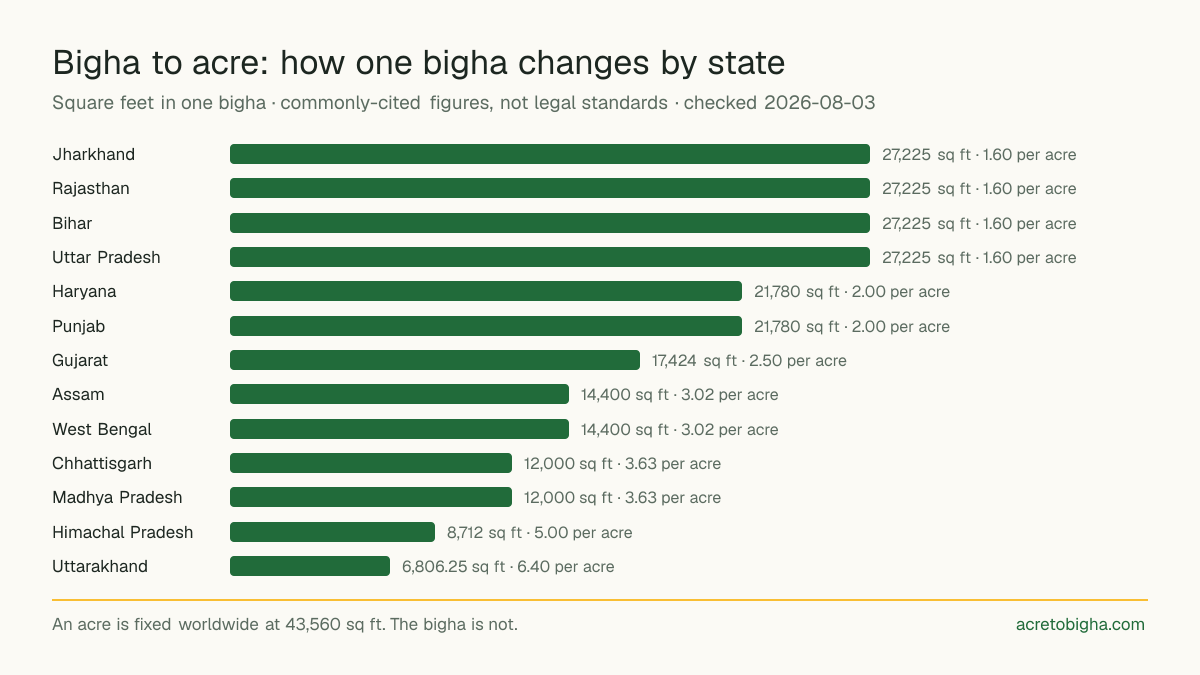
Sorted smallest bigha first, so the scale of the variation is visible at a glance. Select any row to load that state into the converter above.
- State-specific values, not one number for all of India
- 100% free, no signup
- Your calculations never leave your browser
Short answer
Bigha is not a standardised unit
Commonly-cited approximate figure — confirm the exact local value with your state or district land revenue department before any transaction.Which Indian state has the largest and smallest bigha?
Across the thirteen states covered here, the largest bigha is 27,225 square feet, used in Uttar Pradesh, Bihar, Jharkhand and pucca Rajasthan. The smallest in regular use is the Uttarakhand hill bigha at 6,806.25 square feet — exactly one quarter the size, for the same word. Himachal Pradesh sits close behind at 8,712 square feet, which gives the cleanest ratio in India: exactly five bigha to an acre. In between sit Madhya Pradesh and Chhattisgarh at 12,000, West Bengal and Assam at 14,400, Gujarat at 17,424, and Punjab and Haryana at 21,780. Six of these states run more than one convention at once, so the state name alone does not always fix the figure. All values are commonly-cited references derived from each state's traditional definition in square yards, biswa, katha, kanal or guntha — not legal standards. Verify locally before a transaction. Last checked 2026-08-03.
At a glance: bigha size by state
A reference page for every state
What other acre to bigha converters get wrong
These are not hair-splitting differences. Three of the four are wrong by a factor of two or more, which on an agricultural plot is the difference between the land you think you are buying and the land you actually get. Each was published on a working converter or in a search result in August 2026. We do not name the sites — the point is to help someone who has already seen the wrong number, not to score a point.
Uttar Pradesh
- Commonly published
- 6.25 bigha per acre
- What it should be
- 1.6 bigha per acre
- Why the wrong figure exists
- That is the western-district bigha of about 6,806 sq ft, quoted as though it applied to the whole state. In Varanasi or Lucknow it is out by roughly four times.
West Bengal
- Commonly published
- 1.6 bigha per acre
- What it should be
- 3.025 bigha per acre
- Why the wrong figure exists
- That is the North Indian pucca bigha figure applied to Bengal, whose bigha is a little over half the size. It understates the plot count by nearly half.
Rajasthan
- Commonly published
- 1 bigha = 1.6 acres
- What it should be
- 1 bigha = 0.625 acres
- Why the wrong figure exists
- The ratio inverted. One acre is about 1.6 bigha, not the other way round — a bigha is always smaller than an acre in every state that uses it.
Haryana
- Commonly published
- 1 bigha = 0.24 acre
- What it should be
- 1 bigha = 0.5 acres
- Why the wrong figure exists
- Roughly half the correct value, and it ignores that Haryana transacts in kanal and marla rather than bigha in the first place.
The pattern behind all four is the same: a real local figure applied to the wrong scope, or a ratio written the wrong way round. It is why every figure on this site names the state it belongs to, links the definition it derives from, and carries the date it was last checked.
How each figure is calculated
There is no formula for bigha in the way there is for hectare to acre. A hectare is defined against the metre; a bigha is defined against whatever measuring rod, rope or chain a particular revenue survey happened to use. What each state has instead is a convention — a traditional definition in square yards, biswa, katha, kanal or guntha.
So we start from that traditional definition, convert it to square feet, and then divide into the acre's fixed 43,560 square feet. Uttar Pradesh's pucca bigha is 3,025 square yards, which is 27,225 square feet, which is exactly 1.6 to an acre. Himachal Pradesh's is 968 square yards, or 8,712 square feet, which is exactly 5. The clean numbers are a sign the definition is being followed rather than a rounded figure being repeated.
Where a state runs two or more conventions at once — pucca and kaccha in Rajasthan, hill and plain in Uttarakhand, sixteen-guntha and twenty-guntha vigha in Gujarat — the table lists each of them under the state rather than averaging them into one misleading number.
Key facts about bigha across India
- An acre is fixed at exactly 43,560 square feet worldwide. A bigha has no fixed size anywhere.
- Across the states listed here, a bigha ranges from 6,806 square feet in the Uttarakhand hills to 27,225 square feet in Uttar Pradesh, Bihar, Rajasthan and Jharkhand — a fourfold spread for the same word.
- The widely-quoted '1 acre = 1.6 bigha' is the North Indian pucca bigha. It is wrong by half or more in West Bengal, Madhya Pradesh, Himachal Pradesh and Uttarakhand.
- Pucca means the larger, officially-recorded measure and kaccha the smaller local one — typically a half or a third of the pucca.
- The sub-unit is often the real trap. A Bihar bigha holds 20 katha; an Assam bigha holds 5. West Bengal and Assam share the same 14,400 square foot bigha but divide it four times differently.
- Indian property listings routinely mix bigha, acre, guntha, kanal, marla, katha and square feet in the same advertisement. Normalise everything to square feet before comparing prices.
- Official land records are now kept in metric units in most states, but the traditional units survive in conversation, listings, inheritance and family settlements.
- The bigha is not only Indian. Bangladesh uses the same 14,400 square foot bigha as West Bengal, while Nepal's is 72,900 square feet — larger than an acre and a half.
Accuracy and assumptions
These are commonly-cited reference values gathered from publicly available land-measurement references, not an official legal standard. No Indian authority publishes a binding bigha-to-acre table, because the bigha is customary rather than statutory.
Figures can vary within a state as well as between states. Bihar's bigha is consistent but its katha is not; Uttar Pradesh's varies by roughly four times between its western and eastern districts. Punjab and Haryana are the least settled of all — sources disagree between a four-kanal bigha of 21,780 square feet and a local one of about 9,072, which is why kanal and marla are the safer units there.
For a property transaction, confirm the exact local figure with your state or district land revenue department. Treat this table as the thing that tells you which question to ask, not as the answer itself.
Who should use this page
Comparing land across states
An inherited plot listed in bigha in Bihar against a purchase quoted in vigha in Gujarat. The word is the same and the areas differ by more than half.
Moving between regions
Someone used to acre-based figures in Punjab reading a listing in katha in West Bengal, with no intuition for what the number means.
Working with records
Agents, lawyers, students and researchers reading revenue documents that use different units in neighbouring districts.
Just need one quick conversion?
The homepage carries the same converter with a fuller explanation of how bigha works, worked examples for three states, and the full FAQ set. This page is for when you need to compare states side by side.
Go deeper on a state
Questions about state-wise conversion
How many bigha is equal to one acre in Gujarat?
In Gujarat one acre is commonly cited as 2.5 bigha (vigha), taking one vigha as 16 guntha or 17,424 square feet. Parts of the state count a vigha as 20 guntha, which makes it 21,780 square feet and exactly 2 vigha to an acre. Because the guntha is the stable unit at 1,089 square feet and 40 to an acre, ask for deals in guntha or square metres.
Gujarat land units explainedWhy does the size of a bigha change from state to state?
The bigha pre-dates both the metric system and modern state boundaries. It grew out of local revenue surveys that each used their own rod, rope or chain length, so neighbouring regions settled on different sizes. Those conventions were recorded in colonial-era settlement records and survive in everyday use even though official records are now metric.
The full explanationWhat is the difference between a pucca and a kaccha bigha?
A pucca (literally 'firm') bigha is the larger, officially-recorded measure; a kaccha bigha is a smaller local one, typically a half or a third of the pucca. In Rajasthan a pucca bigha is 27,225 square feet against a kaccha bigha of 17,424. Always establish which one a seller means before agreeing a price.
Pucca vs kaccha in detailCan I use this conversion for a property registration?
No. Treat every figure here as a planning estimate, not a legal measurement. Registration, mutation and mortgage paperwork must use the area recorded by your district land revenue office or a licensed surveyor. This tool is for understanding a listing quickly and knowing which questions to ask.
How to verify your local unitPrivate by design
The table and the converter both run entirely in your browser from data shipped with the page. Nothing you type is sent anywhere and there is no account. The only third-party script on the site is Google Analytics, which counts page views and is covered in the privacy policy.
Find your state's real number
Pick your state in the converter, note the square footage behind the ratio, and check whether a second convention is listed for it. Then take that figure to your local land revenue office and confirm it before any money moves.
Commonly-cited approximate figure — confirm the exact local value with your state or district land revenue department before any transaction.